


 Sonar Tracker
Results and the school year
KS4 results day
On KS4 results day you upload year 11’s exam results into the Exams data set in Sisra Analytics and publish them. In 2026, schools received GCSE results from 12:01am on Wednesday 19 August 2026, and pupils at 8am on Thursday 20 August 2026. The Joint Council for Qualifications (JCQ) sets the dates, which change every year.
Before you start
Section titled “Before you start”You need:
- an authority group with Access Data Section, such as Admin
- year 11 set up and published, with the jobs in Prepare before results day done
- the year’s embargo window, from Juniper Education’s announcement (see The 2026 embargo windows)
Year 11 is the cohort such as 26/27 (Current Yr 11). Cohort labels move on only after results day.
Prepare before results day
Section titled “Prepare before results day”Some of these take time, and some cannot be done on the day. In the weeks before results day, make sure that:
- your school has opted in to the year’s Sisra Data Collaboration event, if it takes part (Take part in Sisra Data Collaboration)
- year 11’s statuses and filters match the spring census (Check cohorts against the spring census)
- banked results, such as early entries and exams taken at other centres, are in Exams with the date each was sat
- each qualification you want in the reports is included on the Matching page
- each included qualification has an Expected Attainment Pathway (EAP) and, if current, a qualification number (QN)
- no qualification shows a warning icon under DC Exams Check
- each EAP has a grade method for the KS4 Exams term, because results use that term’s grade method
- targets and anything else you want to compare with results are published, with the settings you will use for Exams
- the staff who may see results during the embargo have access (Let more staff see embargoed reports)
Banked results matter because the earliest entry in a qualification counts in the headline measures. Compare targets and Exams only if both use the same DfE Rules from:, A8 Estimates: and VA Estimates:.
If you use Sisra only for exam results
Section titled “If you use Sisra only for exam results”If year 11 has never been set up, set it up in this order. It needs no expected grades.
- Create grade methods for each kind of qualification, such as GCSE 9 to 1 single and double award, and each vocational qualification. See Create grade methods.
- Import student data as at the spring census.
- Upload KS2 scaled scores for English reading and maths, and nominate them as Core. See Upload KS2 baselines.
- Create one EAP for each grade method, using the same method in every term. See Set up EAPs for KS3/4.
- Upload targets first, so that every qualification exists, then any banked results.
- Assign qualifications to classes, complete the Matching page and clear any warnings in Grades Management.
- Publish student data, KS2 / EAP and your targets.
Get the results file ready
Section titled “Get the results file ready”- Export the results from your MIS or exams software once the results files from the exam boards (awarding organisations) are in it. Include each pupil’s Student ID, name, qualification and grade.
- Check that the Student IDs are the ones your student data uses, such as admission numbers.
- Rename qualifications to match the names on your Matching page, for example with Find and Replace in Excel. Names that match join their existing qualification with no extra step.
- Remove the dashes from any combined science grades, such as 6-5, as Combined science results explains.
- Save the file as .csv, .xlsx, .xls or .xml.
Combined science results
Section titled “Combined science results”Exam boards can send combined science grades with a dash, such as 6-5. Sisra cannot read them that way. It needs the two grades together with the higher grade first, such as 65, 55 or 54.
- Open the results file in Excel and select the combined science column.
- Press Ctrl + F, then select the Replace tab.
- Enter a dash in Find what: and leave Replace with: empty.
- Select Replace All, then save the file.
On the Matching page, combined science must be one qualification, linked to the combined science QN. Its EAP must use a grade method with split grades for double award. Two single-award rows will not calculate in line with the DfE.
Upload the results
Section titled “Upload the results”- Open year 11 in DATA, as in Open a cohort in DATA.
- Select Grades, then Uploads, then Exams. Exams is fixed to the term KS4 Exams and the grade type Exams.
- Select Upload Grade File.
- Choose Broadsheet or Grade List to match your file, then choose the file.
- In Exams Date:, enter a date in the summer exam series. Enter a file title of 2 to 20 characters, then select Upload.
- On Column Mapping - Grade Data, check that Student ID, Student Name, the qualifications and the grades are mapped. Select Continue with the upload.
- Read the file health check. If the numbers of pupils and qualifications are what you expect, select Continue with the upload.
- If Confirm Upload Qualification Names opens, set each qualification that is new to the cohort to New. For one that is only named differently, choose its existing name. Then select Complete the upload.
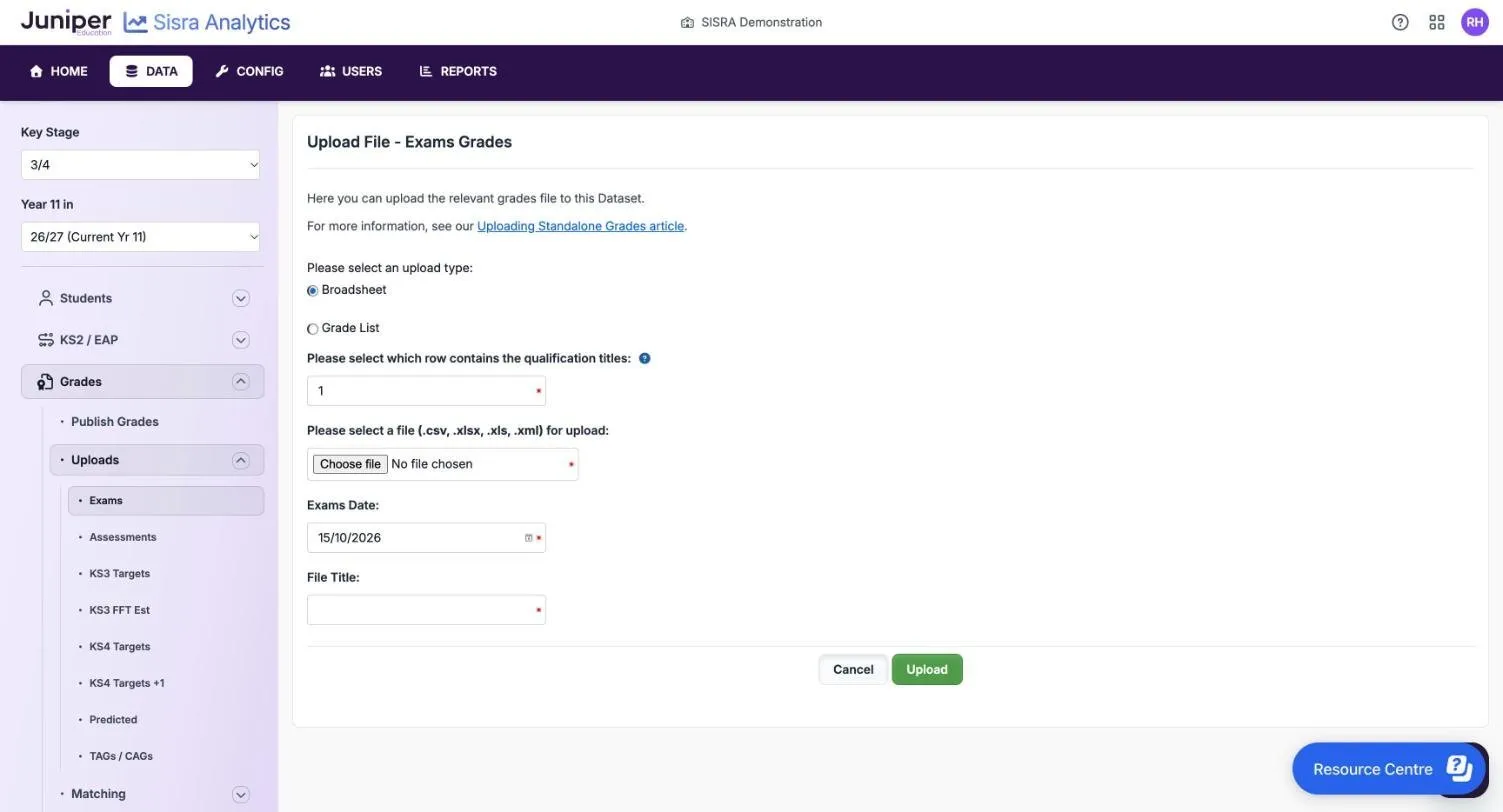
Upload grades explains each step and the file health check.
Match new qualifications and check the grades
Section titled “Match new qualifications and check the grades”- If the upload created new qualifications, assign them to sets of classes: select Students, then Classes, then Assign Quals.
- Select Grades, then Matching, then Qualifications, then Edit.
- For each new qualification, set Included to Yes, choose its EAP, set Use QN to Yes and search for it in QN Title. An AS level taken in the same subject as a GCSE needs its own row and QN.
- Select Save Changes.
- Check the DC Exams Check column. A warning icon there means the EAP’s grade method for the KS4 Exams term differs from the one the QN expects. Grades may then get the wrong points. Select the magnifying glass next to it to compare them, then fix the grade method or the EAP.
- Select Grades Management, then Manage Datasets, and choose Exams. Check each Grades Count, and clear any warning icons.
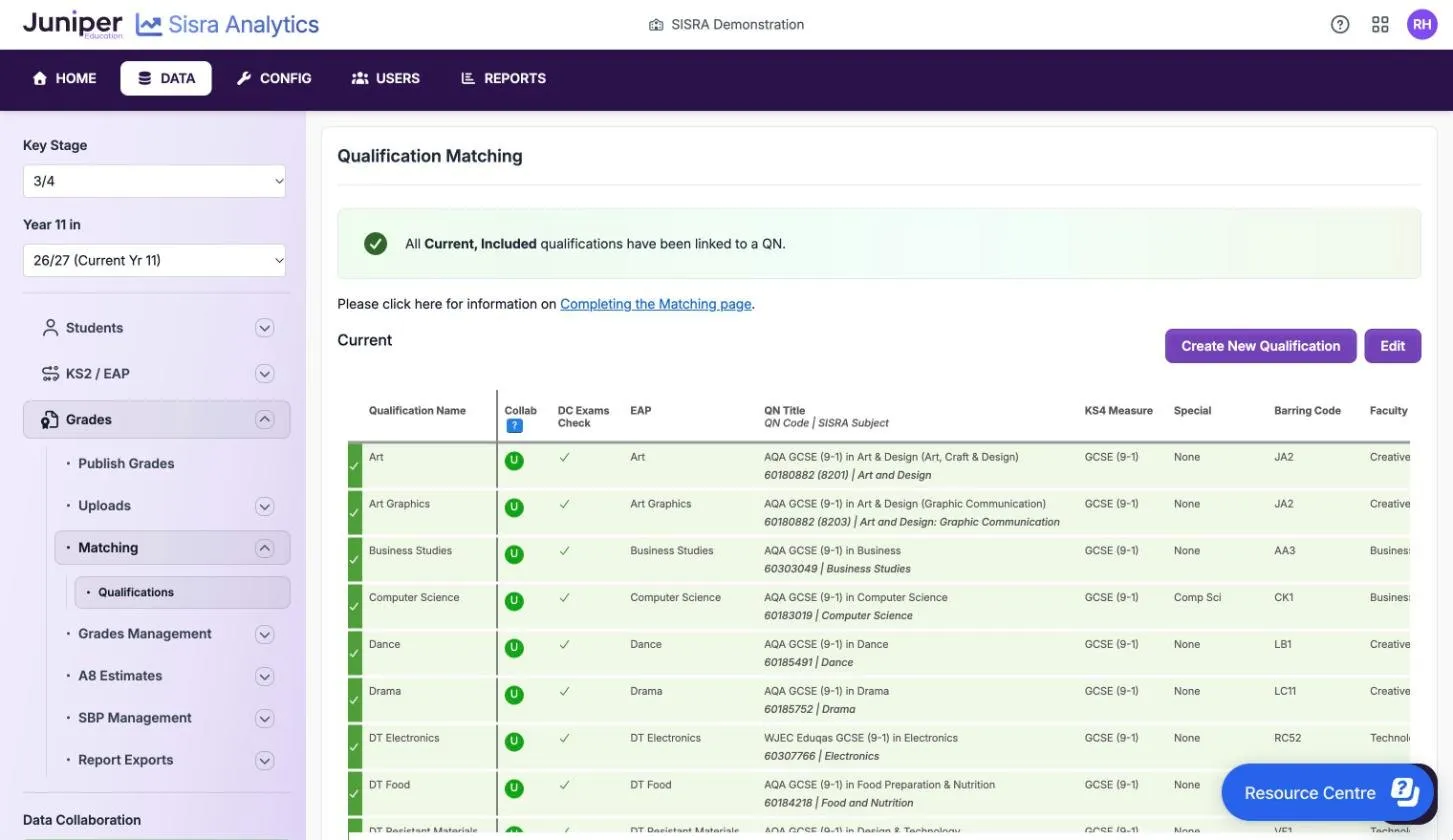
You cannot publish Exams until every issue on its health check is fixed. Match qualifications in KS3/4 covers unapproved qualifications, and Warning icons explains each icon.
Publish the results
Section titled “Publish the results”- Publish student data, then KS2 / EAP, as in Publish in the right order. New qualifications need both.
- Select Grades, then Publish Grades, and select Publish on the Exams row.
- Read the Health tab, and fix anything that fails.
- On the Publishing tab, choose the options in the next table.
- Select Publish.
| Option | What to choose for Exams |
|---|---|
| Report Status: | The status staff get when the embargo ends. Choose Locked to hold results back for longer |
| Headlines | On, with the latest DfE Rules from: year: 2022, as at October 2026 |
| A8 Estimates: and VA Estimates: | The estimates Juniper advises for the cohort. See Choose the publishing options |
| Data Collaboration | On, if your school takes part |
Published inside the embargo window, Exams is embargoed until the window closes: in 2026, at 8am on Thursday 20 August 2026. Until then, only staff with View Embargo Reports can open it. Progress 8 needs published KS2 results: the 25/26 cohort had none, but the 26/27 cohort took KS2 tests in 2022. See Progress 8 for cohorts without KS2 results.
When the report is ready, open it from REPORTS. Check the headline figures for blanks and surprises, such as the cohort size and the number of pupils included. Headlines reports describes each figure.
Include your results in Data Collaboration
Section titled “Include your results in Data Collaboration”If your school takes part, Sisra collects your results for that year’s Sisra Data Collaboration from an Exams publish made inside a collection window. In 2026, the figures from window 1 became available at 3:45pm on Thursday 20 August 2026.
To be included, you need to:
- publish Exams before the window closes
- finish the set-up: key filters mapped, KS2 / EAP published, and every current qualification linked to a QN
The Data Collaboration panel at the foot of the menu in DATA shows Setup and Publish at 100% when the set-up is complete. Each year’s windows are on the event’s opt-in page in CONFIG, under Post-Results Collection Windows. About Sisra Data Collaboration explains how the figures are built.
After results day
Section titled “After results day”Republish with collaborative data
Section titled “Republish with collaborative data”Juniper announces on the HOME page when that year’s collaboration figures are ready. In 2026, the announcement “KS4 2026 Exams Data Collaboration Data Released!” was dated 20 August 2026. Then:
- Publish Exams again, with Data Collaboration on and that year’s Collaboration Data:, such as 2026 Collab.
- Choose the A8 Estimates: and VA Estimates: Juniper advises for the cohort.
- Publish the data sets you compare with Exams again, with the same choices.
Record re-marks and late results
Section titled “Record re-marks and late results”- For a re-mark, select Grades, then Grades Management, then Manage Students. Choose the pupil and Exams, select Edit Grades, enter the new grade and select Save.
- For a late result, upload a file of the late grades alone into Exams, or add each one in Grades Management with Add Grade.
- Publish Exams again.
The DfE’s provisional data, published each October, does not include re-marks. Its revised data, early in the following year, does.
Other jobs
Section titled “Other jobs”After results day you may also need to:
- put Exams in the last slot of the tracker (Generate the tracker and flight paths)
- keep results from staff for longer (Keep results hidden after the embargo)
- compare the DfE’s data with your Exams report in October (Use the DfE’s checking exercises)
If something goes wrong
Section titled “If something goes wrong”Exams will not publish. The health check has found a problem. These are the usual ones:
| Warning | Usual cause |
|---|---|
| Grade Not In Method | A grade the qualification’s grade method does not have, such as a combined science grade with a dash |
| Missing Student Data | A Student ID that is not in your student data |
| Subgrades Not Valid In This Dataset | A grade with a + or - sign, which Exams cannot hold |
Staff cannot see the results. The embargo, a Locked status or their authority group is stopping them. See Report status and the results embargo.
An early entry counts instead of the summer result. That is the DfE’s first entry rule: the grade with the earliest exam date counts in headline measures. Check the dates, and correct any wrong ones in Grades Management with Edit Date.
Progress 8 is blank. The cohort has no published KS2 results, or the KS2 baseline type does not match the estimates. See Progress 8 for cohorts without KS2 results.
Publishing is slow. Many schools publish on results days. The Results Day Information box on the publish pages says queues are longest from 6am to 4pm on the embargo days. You can queue only one item per cohort at a time.
The Data Collaboration options are greyed out. The set-up is not complete. Check the Data Collaboration panel in DATA.