


 Sonar Tracker
How Sisra works
Progress 8 for cohorts without KS2 results
Pupils who left year 11 in 2025 and 2026 sat no KS2 tests, so the DfE publishes no Progress 8 for them. This page explains what Sisra Analytics shows for these two cohorts, the options schools have used and their limits, and what changes for later cohorts. The DfE’s position is still changing, so each fact here carries its date.
Why there are no KS2 results
Section titled “Why there are no KS2 results”The KS2 tests, often called SATs, were cancelled in 2019 to 2020 and 2020 to 2021 because of COVID-19. The pupils in year 6 in those years left year 11 in summer 2025 and summer 2026. In Sisra they are the 24/25 and 25/26 cohorts, and by October 2026 both are leavers.
Without KS2 scaled scores these pupils have no starting point for Progress 8. The DfE’s secondary accountability guidance says: “It is not possible to calculate Progress 8 for academic years 2024 to 2025 and 2025 to 2026”. The guidance, updated 16 October 2025, adds that “there will be no replacement for Progress 8” for those two years.
What the DfE publishes instead
Section titled “What the DfE publishes instead”For those years the DfE publishes its other headline measures:
- Attainment 8
- English and maths at grade 5 or above (the DfE also reports grade 4 or above)
- English Baccalaureate (EBacc) entry and the EBacc average point score
- destinations
That list comes from its guidance for 2024 to 2025. As at 15 October 2026 its guidance for 2025 to 2026 had not appeared, although schools received their provisional data that day.
Since September 2026 the DfE has also given schools a similar schools model for attainment. It compares a school’s Attainment 8 with that of about 50 similar schools. They are chosen by prior attainment, disadvantage, SEND, EAL and the size and stability of the cohort. Its prior attainment uses KS2 reading and maths scores from all year groups in the school, not only the exam cohort.
The DfE says the model is for schools only, appears in Ofsted’s inspection data summary report, and “will not be used to make grading decisions”. It is not in Sisra.
What Sisra shows
Section titled “What Sisra shows”For the 24/25 and 25/26 cohorts, Sisra calculates the attainment measures as normal. Progress 8, EBacc value added and the Subject Progress Index (SPI) need a KS2 result for each pupil. So they stay blank, and Pupils Included (Progress 8 Coverage) shows 0, unless you upload KS2 scores yourself.
Sisra relaxes its checks for these cohorts. You can publish KS2 / EAP without KS2 scores and leave Core blank on Baseline Management. Data Collaboration still gives collaborative headline figures. Your Expected Attainment Pathways (EAPs) can use another baseline, such as targets. Publish baselines and EAPs covers publishing these cohorts.
The options and their limits
Section titled “The options and their limits”Some schools have produced an internal progress figure for these cohorts. Each option below gives a figure that belongs to the school: it is not the DfE’s Progress 8.
| Option | How it works | The main limit |
|---|---|---|
| Leave Progress 8 blank | Report the attainment measures only, as the DfE does | No progress measure for these cohorts |
| Converted KS2 scores | Upload English reading and maths scores worked out from another test, such as Cognitive Abilities Tests (CAT) taken in year 7 | A different test, taken later, converted in a way each school chooses |
| Juniper Education’s generator spreadsheet | Work out scaled scores from a set of Sisra reports | If it uses the same pupils’ results, the baseline is built from the outcome |
| Data Collaboration estimates | Publish with 2025 Collab - Exams or 2026 - Collab Exams | Built from other schools’ converted scores |
| Custom estimates | Use your own estimates, entered by hand or adjusted from another set | Your own judgement, with no minimum scores |
Converted KS2 scores
Section titled “Converted KS2 scores”To get Progress 8, SPI and EBacc value added, upload scores for English reading and maths between 59 and 120. Then nominate both as Core, with the grade type Scaled Scores. The 2026 Data Collaboration opt-in page says many schools generated such scores “from CAT tests sat when students joined schools in year 7”.
Converted scores come from a different test, taken months after the end of KS2, through a conversion each school chooses. So two schools’ figures are not comparable, and neither is comparable with the DfE’s Progress 8 for other years. For any other cohort, do not enter a KS2 score for a pupil who has none: the DfE leaves such pupils out of Progress 8.
The generator spreadsheet and circular baselines
Section titled “The generator spreadsheet and circular baselines”Juniper provides a spreadsheet that creates scaled scores “from a set of Sisra Analytics reports”, as the opt-in page puts it. It takes each pupil’s Attainment 8 from a Sisra export and turns it into KS2 scores. If that Attainment 8 comes from the same results you then measure, the baseline is built from the outcome. The Progress 8 that follows reflects the conversion, not the pupils’ progress.
Data Collaboration estimates
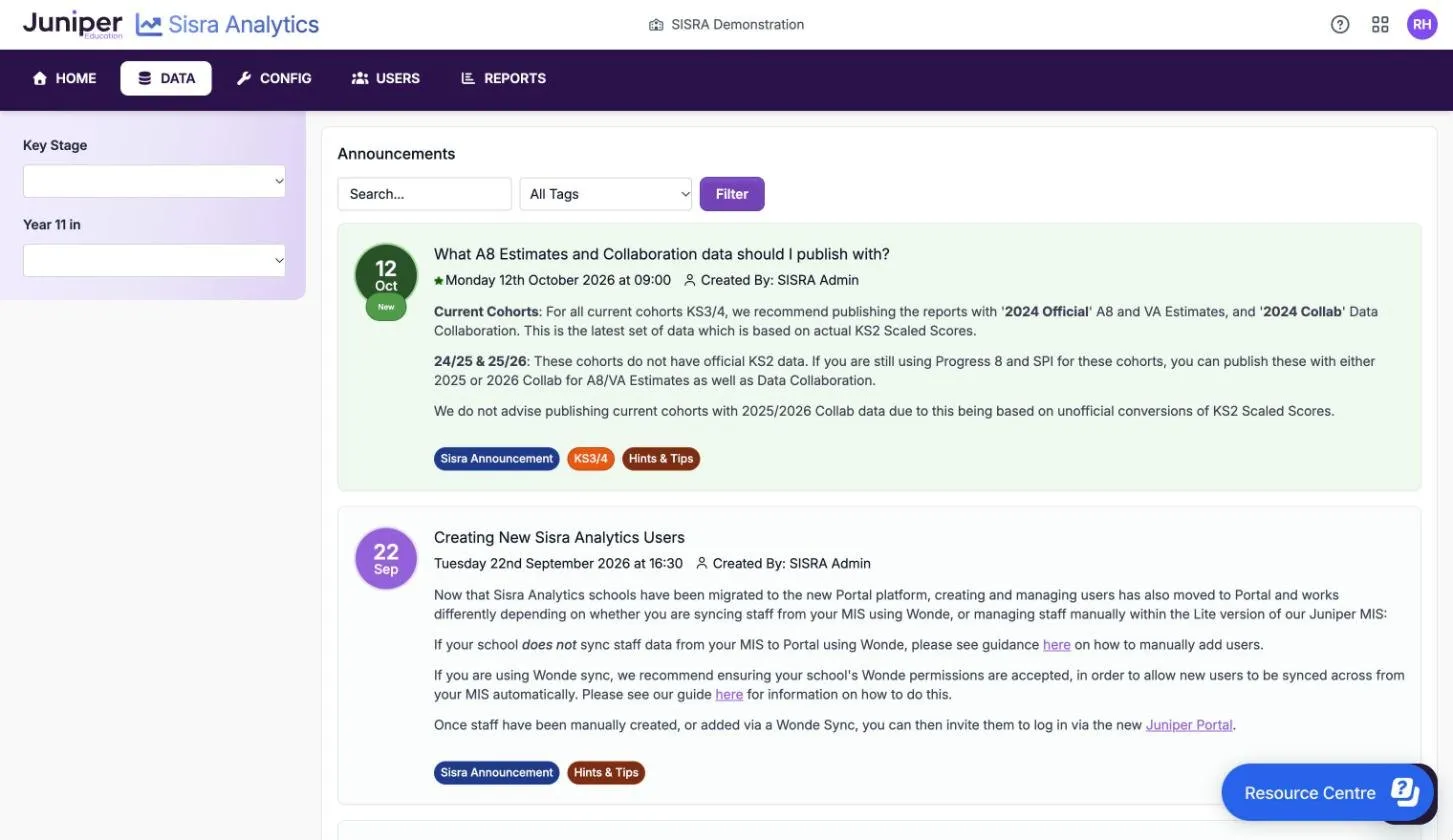
Section titled “Data Collaboration estimates”The 2025 and 2026 Data Collaboration events ran on converted scores. Their Attainment 8 estimates average other schools’ results against those scores, so both sides of the Progress 8 sum rest on unofficial baselines. Juniper’s Home announcement of 12 October 2026 says the 24/25 and 25/26 cohorts can use them. It advises against them for current cohorts, because they are based on “unofficial conversions of KS2 Scaled Scores”.
Custom estimates
Section titled “Custom estimates”You can create your own estimate set, starting blank or from a copy of official or collaboration estimates. Sisra applies no minimum scores to custom estimates. Leaving a custom set blank stops Progress 8 appearing at all, which avoids confusing staff. Create custom Attainment 8 estimates gives the steps.
Label every internal figure
Section titled “Label every internal figure”Whichever option you choose, label the figure as your school’s own. Say which baseline and which estimates it uses, and do not compare it with the DfE’s Progress 8 for other years. Good practice with school data sets out what the DfE says about forecasting and sharing progress scores.
What returns for 2026 to 2027
Section titled “What returns for 2026 to 2027”The DfE says “It will be possible to produce Progress 8 in 2026 to 2027”. Pupils leaving year 11 in 2027, Sisra’s 26/27 cohort, took KS2 tests in 2022, so Sisra calculates their Progress 8 from real scores. The DfE adds that it will consider how to include pupils assessed against the engagement model.
The open question is which estimates to use. The DfE’s averages for 2027 come from the 2027 results, so they cannot appear before the provisional data in autumn 2027. Until then, any Progress 8 for this cohort uses an earlier year’s estimates.
Juniper’s Home announcement of 12 October 2026 recommends, for all current KS3/4 cohorts:
- the official 2024 Attainment 8 and value added estimates, listed as 2024 in A8 Estimates: and VA Estimates:
- the 2024 collaboration data, 2024 Collab, in Collaboration Data:
The announcement calls the 2024 data “the latest set of data which is based on actual KS2 Scaled Scores”.
The DfE warns that its averages change with national entry patterns and results, and that “any modelling based on current national results can be misleading”. By summer 2027 the 2024 estimates will be three years old. Treat the 26/27 cohort’s Progress 8 as indicative until you republish with the DfE’s 2027 estimates.
The proposed new Progress 8 for 2028 to 2029
Section titled “The proposed new Progress 8 for 2028 to 2029”The DfE consulted on new KS4 measures from 23 February to 4 May 2026 (key stage 4 performance measures consultation). On 15 October 2026 its page still said “We are analysing your feedback”. It proposed keeping Progress 8 and Attainment 8 across eight qualifications, with new slots:
| Slots | Proposed contents |
|---|---|
| 1 | English, double weighted if the pupil takes both English language and English literature |
| 2 | Maths, double weighted |
| 3 and 4 | Science |
| 5 and 6 | Breadth: humanities, creative subjects and languages |
| 7 and 8 | Choice |
At most two technical awards could count across the slots. The model would apply to pupils taking exams in 2028 to 2029: Sisra’s 28/29 cohort, in year 9 in 2026 to 2027.
The consultation also proposed:
- removing the EBacc from the headline measures, as the DfE announced on 4 November 2025
- progress bandings by percentile, showing three years of scores instead of confidence intervals
- a measure for pupils who did not meet the expected standard in KS2 reading and maths
- a new measure of grade 7 or above in English and maths
Until the DfE publishes its decision, treat the new model as a proposal. Sisra calculates the current model for every cohort.