


 Sonar Tracker
How Sisra works
About Sisra Data Collaboration
Sisra Data Collaboration pools the KS4 exam results of schools that use Sisra Analytics and choose to take part. Each school can then compare its results with those of the other schools, weeks before the DfE’s provisional figures in October. In 2026, the first figures were available at 3:45pm on GCSE results day. This page explains who takes part, what is collected, what the collaboration adds to your reports, and its limits.
What it is
Section titled “What it is”Each summer Juniper Education runs a Data Collaboration event for that year’s KS4 results. The schools that opt in have their Exams data collected after the results arrive, without names. From it, Juniper works out:
- collaborative headline figures, such as Attainment 8 and English and maths at grade 5, to compare with your own
- Attainment 8 and value added estimates, which you can use for Progress 8 before the DfE publishes its own
- the average grade in each subject for pupils with each KS2 score, which the Subject Progress Index (SPI) compares with
Data Collaboration covers KS3/4 only. There is no KS5 collaboration.
Who takes part
Section titled “Who takes part”A school’s results are collected only if:
- it opted in to that year’s event, in CONFIG > Data Collaboration > KS3/4 Collaborations
- it is a school in an English local authority
- it finished the set-up: key filters mapped, KS2 core subjects set up and published, and every included qualification matched to its qualification number (QN)
- it published its Exams data set in a collection window, using the DfE rules year the event uses
After collection, Juniper checks the data. A pupil is left out if any of their grades carries different points from the DfE’s for that qualification. Schools that do not report to the DfE can opt in to use the collaboration figures, but their own results are not collected.
The 2022 event drew on 1,433 schools, the 2023 event on 1,495 and the 2024 event on 1,594.
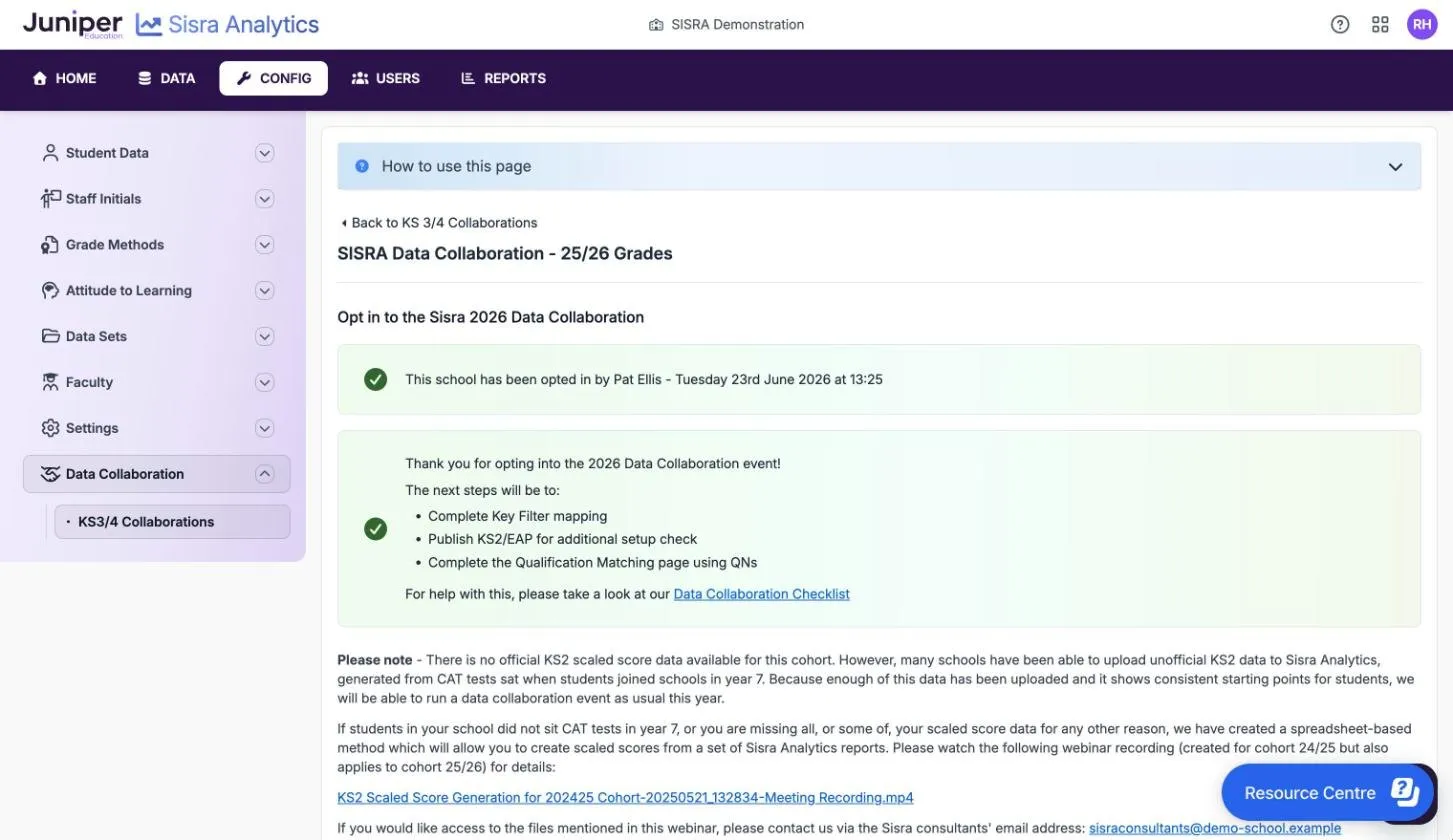
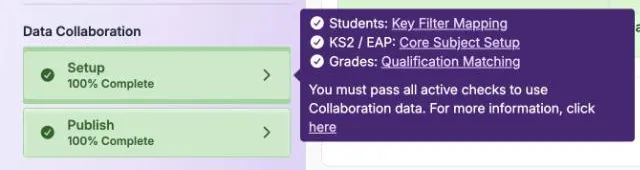
The Data Collaboration panel in DATA shows how far a cohort’s set-up and publishing have got. The KS2 checks do not apply to the 24/25 and 25/26 cohorts, which have no KS2 results. Take part in Sisra Data Collaboration gives the steps.
What is collected and how it stays anonymous
Section titled “What is collected and how it stays anonymous”For each pupil, the opt-in page lists:
- the gender, disadvantaged and SEN values from your key filter mapping
- KS2 scaled scores for English reading and maths
- grades and headline figures from the Exams data set
Only pupils with the status On Roll are collected. Each pupil’s row carries a random ID, and no names or school identifiers go with it. The figures that come back are averages across all the schools that took part. The opt-in page for each event also has a section on data protection.
Collection windows
Section titled “Collection windows”The collaboration takes only Exams publishes made after the results arrive and before a collection window closes. In 2026, the figures from window 1 became available at 3:45pm on Thursday 20 August, GCSE results day. Juniper’s Home page announcement that the 2026 collaboration data had been released is dated the same day.
The opt-in page for each event lists its windows, when each closes, and when the SPI, estimates and headline figures become available. Once a window has closed, the page shows Window closed instead of its close time. An event can have more than one window. Each window’s figures carry its number, such as 2025 Collab Window 1 in the publishing details on Publish Grades.
To see the figures, republish the Exams data set with Data Collaboration on and the event chosen in Collaboration Data:. Republish any data set you compare with it in the same way.
What it adds to the reports
Section titled “What it adds to the reports”A report published with Data Collaboration on gains:
- blue columns on the Headlines Summary, giving each measure across the collaboration and your difference from it
- breakdowns by gender, disadvantaged and SEN that compare like with like, such as your disadvantaged pupils with all disadvantaged pupils in the collaboration
- the SPI, in the Grades reports and the SPI Scattergraph
Each such report also shows which event and window it uses. The collaboration’s estimates appear in A8 Estimates: and VA Estimates:, under Data Collaboration:, when you publish. Data Collaboration in the reports describes the columns and their colours.
Estimates and the SPI
Section titled “Estimates and the SPI”Juniper builds the collaboration’s estimates the same way as the DfE builds its averages, but from the collaboration’s pupils only. Pupils are grouped by their KS2 average score. The Attainment 8 estimate for each group is the average Attainment 8 of the pupils in it. Each element of Attainment 8 is averaged in the same way.
The 2025 and 2026 sets also hold minimums for adjusted Progress 8, but only for KS2 averages of 100.5 and above. The report’s help says adjusted scores apply only with official DfE estimates. This guide could not confirm whether a school’s own Progress 8 is adjusted when published with collaboration estimates.
For the SPI, Juniper averages the points of the grades in each group of similar subjects, for pupils with each KS2 score. Sisra hides an average built from fewer than 10 grades. It marks an average built from 10 to 24 grades as based on low numbers. Subject Progress Index explains how a pupil’s SPI is worked out.
The 2025 and 2026 events ran on converted KS2 scores, because those cohorts sat no KS2 tests. So their estimates do not suit cohorts with real KS2 results. Progress 8 for cohorts without KS2 results gives Juniper’s advice on which estimates to use.
Why it is not national data
Section titled “Why it is not national data”Collaboration figures are an early comparison, not national figures:
- they come only from schools that use Sisra, opted in, finished the set-up and passed Juniper’s checks
- they are collected around results day, before late results, re-marks and the DfE’s checking exercises
- the schools choose to take part, so their pupils may differ from pupils nationally
- the 2025 and 2026 events rested on converted KS2 scores
The DfE’s averages cover all pupils in state-funded mainstream schools, and arrive with the provisional data in October. Once the DfE’s figures for a year are in Sisra, republish that year’s reports with them.