


 Sisra Analytics
Reports
EYFS reports
These reports use the summative judgements recorded for nursery and reception children on EYFS Summative Assessment (New). EYFS Good Level of Development Tracking has no primary equivalent, and most other reports have an EYFS version, listed in EYFS versions of other reports. EYFS profile results are in End of Reception Outcomes instead.
Good Level of Development Tracking
Section titled “Good Level of Development Tracking”EYFS Good Level of Development Tracking shows each reception child’s judgement in the goals that make up a good level of development (GLD). Use it to see who is on track and which goals hold children back. Open it from Reports for one reception class: nursery year groups are not offered.
A child reaches GLD at the end of reception if they are at the expected level in 12 early learning goals (ELGs). These are the goals in the three prime areas, literacy and mathematics. The prime areas are communication and language; personal, social and emotional development; and physical development. EYFS profile lists the goals.
Options
Section titled “Options”Choose the assessment point, which starts at the current one, such as 2026-2027 Autumn 1. Use Filters to narrow the children.
Read the report
Section titled “Read the report”After Pupils comes a column for each goal, with shortened headings. In order, they are Listening, Attention and Understanding; Speaking; Self-Regulation; Managing Self; Building Relationships; Gross Motor Skills; Fine Motor Skills; Comprehension; Word Reading; Writing; Number; and Numerical Patterns.
Each cell shows the child’s judgement in that goal, and Just At or higher counts as at age-related expectations (ARE):
| Code | Judgement | Counts as at ARE |
|---|---|---|
| B pink | Below | No |
| JA yellow | Just At | Yes |
| At light green | Securely At | Yes |
| A green | Above | Yes |
| - (dash) | No judgement at this point | No |
Number of Goals AT ARE counts the goals where the child is Just At or higher, out of 12. Summative Assessment for GLD Met shows YES only when all 12 are, which means the child is on track for GLD at this point. The Summary row gives the percentage and number at ARE in each goal, the average number of goals at ARE and the share meeting GLD.
In the demo school’s reception class at autumn 1, the Summary row shows Word Reading at 81.3% (13/16). The average is 10.3 goals at ARE. No child has a Comprehension judgement yet, so every child shows NO, even Theodore Bell, who is at ARE in the other 11.
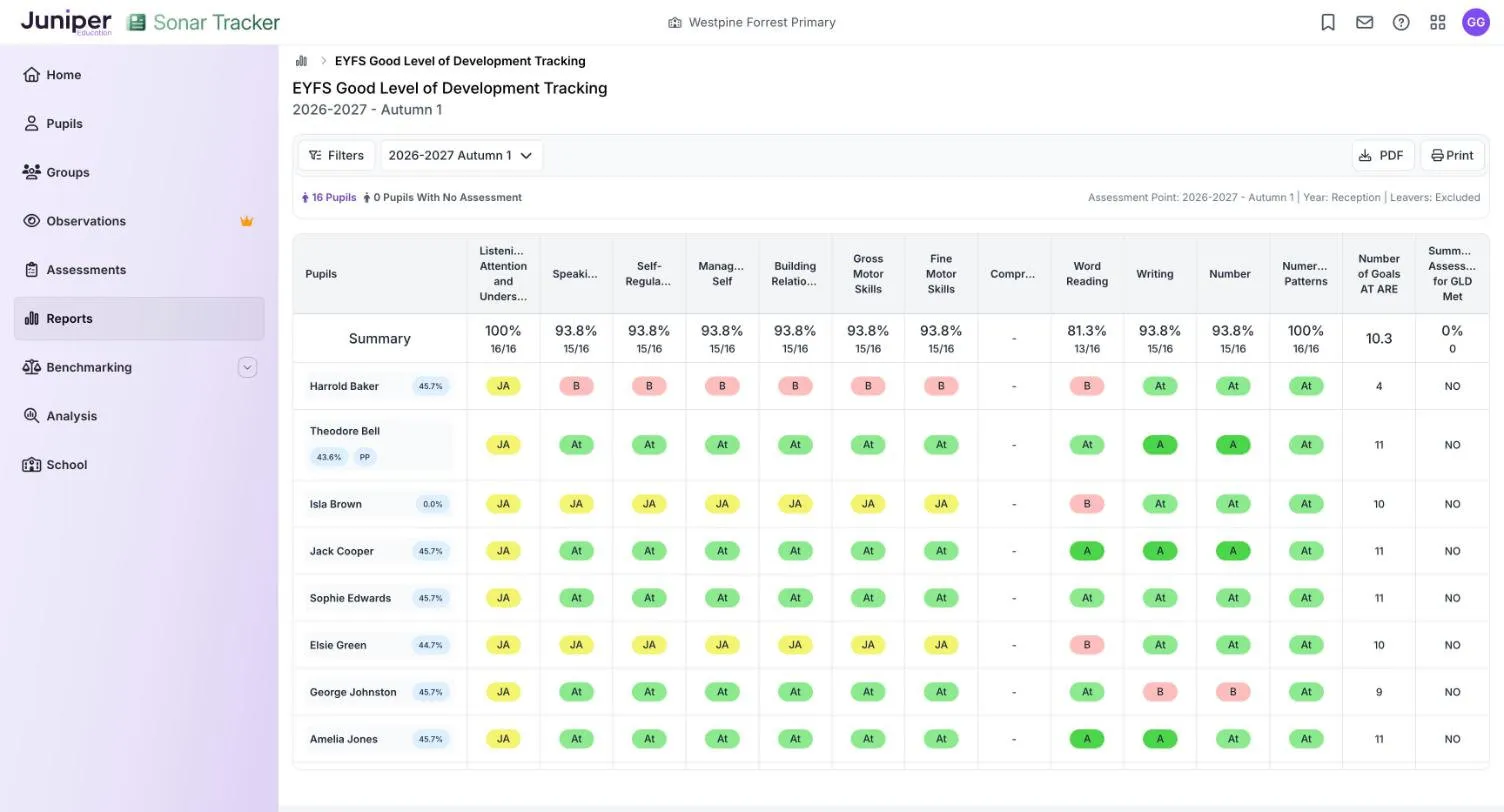
To find children one goal short of GLD, look for 11 in Number of Goals AT ARE. Then find the B or dash in each of those rows. A dash means no judgement, not Below: George Johnston’s 9 comes from B in Writing and Number and no Comprehension judgement.
Points to watch
Section titled “Points to watch”Just At counts as at ARE, but a child who is Just At has little margin: a long absence could take them off track.
Children with gaps still appear, and each dash counts against them. Check that judgements are complete with Check data entry before you read Summative Assessment for GLD Met.
These are teachers’ judgements during the year. Whether a child reaches GLD is decided by the EYFS profile at the end of reception.
In a class of 16, each child is worth 6.25 percentage points: 15 of 16 shows as 93.8%.
EYFS versions of other reports
Section titled “EYFS versions of other reports”Most of Sonar’s other reports have an EYFS version. The older ones carry (2020) in their names, which refers to the reformed EYFS framework and its 17 early learning goals. They work like the primary versions, with goals or areas of learning in place of subjects. Most summative ones open on Word Reading, Writing and Number.
| EYFS report | Where it is described |
|---|---|
| EYFS (2020) Age Related Overview | Age Related Overview |
| EYFS (2020) Venn | Venn |
| EYFS Characteristic Attainment Overview | Characteristic Attainment Overview for EYFS |
| EYFS (2020) Age Related Progress | Age Related Progress |
| EYFS (2020) Assessment Conversion Matrix | Assessment Conversion Matrix |
| EYFS (2020) Quadrant | Quadrant |
| EYFS (2020) Summative Progress Analysis (ARE) | Summative Progress Analysis (ARE) |
| EYFS (2020) Summative Progress Analysis | Summative Progress Analysis |
| EYFS (2020) Formative Progress Analysis | Formative Progress Analysis |
| EYFS Cohort Formative Analysis, where your school has it | Cohort Formative Analysis |
| EYFS (2020) Target Analysis | Target Analysis |
| EYFS Projection Summary, where your school has it | Projection Summary |
| EYFS Summative Data Check Summary | Check data entry |
| End of Reception Outcomes | End of Reception Outcomes |
| EYFS Benchmarking Analysis, with the Benchmarking module | Benchmarking |
Take EYFS (2020) Age Related Overview for the demo school’s reception class at autumn 1. Just At or higher in all subjects shows 75.0% (12), where the subjects are the three goals chosen. In Word Reading, 3 of the 16 children (18.8%) are Below, 9 (56.3%) Securely At and 4 (25.0%) Above.
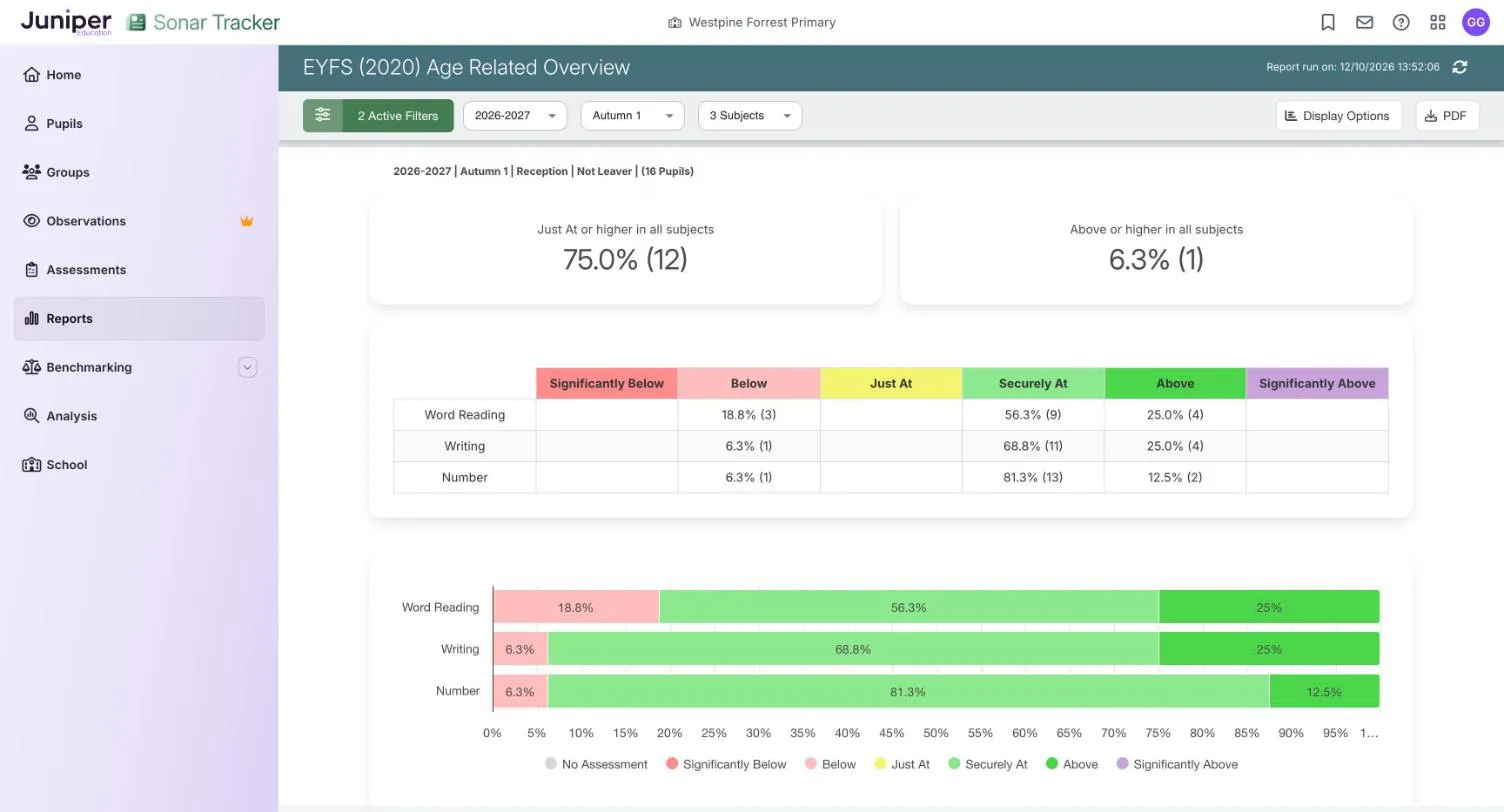
Unlike the primary version, EYFS (2020) Age Related Overview has no list for choosing test scores instead of judgements.
Characteristic Attainment Overview for EYFS
Section titled “Characteristic Attainment Overview for EYFS”EYFS Characteristic Attainment Overview compares groups of children, such as boys and girls, in one goal at one assessment point. It works like the primary version, which describes its columns.
Options
Section titled “Options”| Option | What it does | Default |
|---|---|---|
| Assessment point list | The point to report on | The current point |
| Goal list | One goal, listed under The prime areas and The specific areas | Listening, Attention and Understanding |
| Characteristics list, such as 36 Selected | The groups shown as rows: Gender, Disadvantaged, FSM (free school meals), Pupil Premium, SEN (special educational needs), EAL (English as an additional language), Ethnicity, Attendance Band, Summer born and Leaver | All ticked |
Read the report
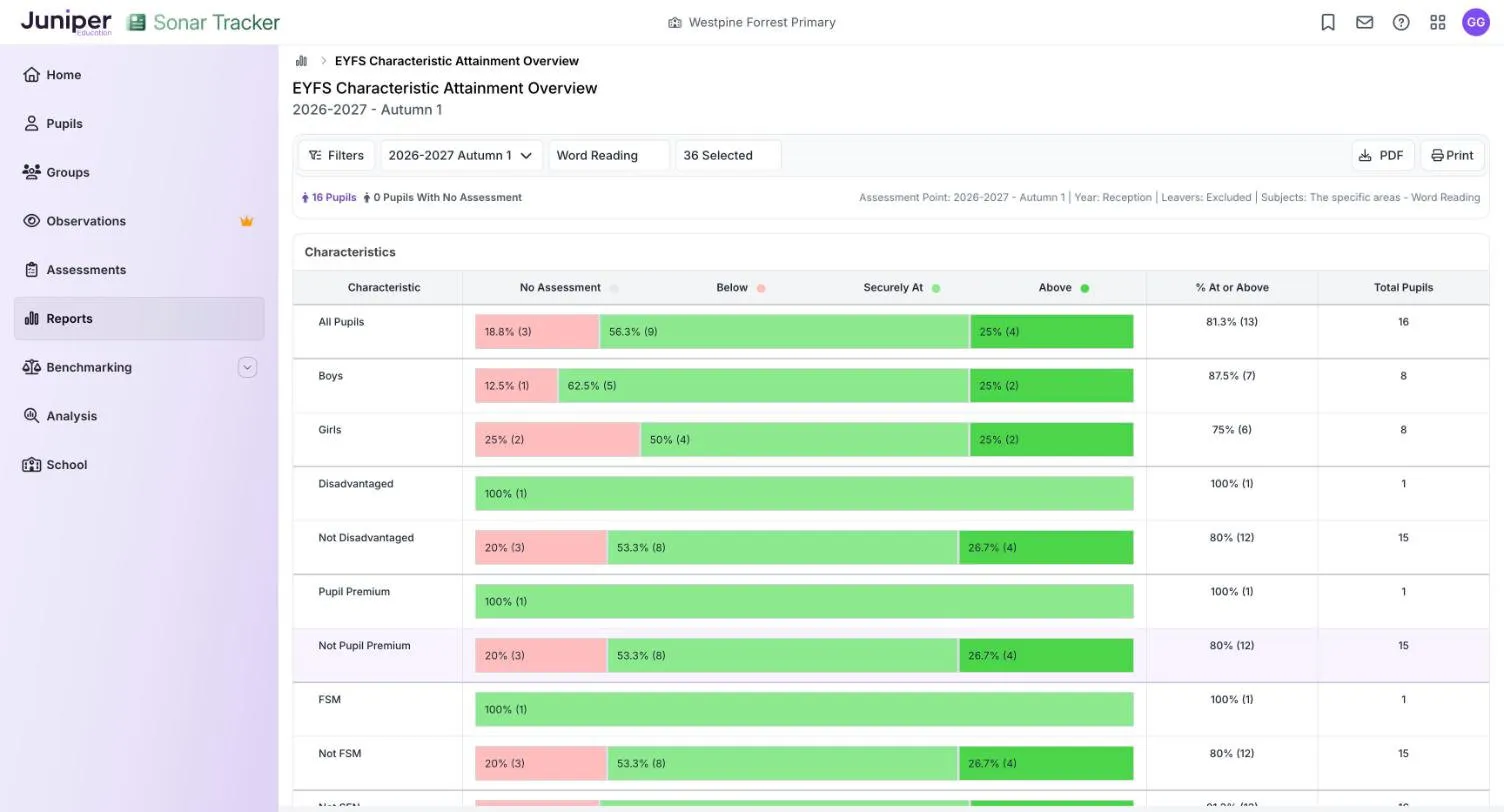
Section titled “Read the report”Each row of the Characteristics table is a group, starting with All Pupils. It shows a bar split by judgement, then % At or Above and Total Pupils. The bar uses the colours in the Good Level of Development Tracking key, with grey for No Assessment.
In the demo school’s reception class, Word Reading at autumn 1 has % At or Above of 81.3% (13 of 16). Boys are at 87.5% (7 of 8) and girls at 75% (6 of 8), a gap of 12.5 percentage points: one child.
Points to watch
Section titled “Points to watch”% At or Above includes Just At. Every child in the demo class is Just At in Listening, Attention and Understanding, so that goal shows 100%.
Each percentage is a share of that row’s group, and many groups are one or two children: in the demo, Disadvantaged is 1 child. The DfE’s 2018 report ‘Making data work’ puts the gap needed for a meaningful difference in a one-form-entry primary at about 40 percentage points. Give the number of children with every percentage you report.