


 Sisra Analytics
Assessment in Sonar
Judgements, bands and age-related expectations
Every summative judgement in Sonar Tracker has a fixed meaning, and reports, benchmarking and parent reports rely on it. Use this page when you agree as a staff what each judgement means, and to see how Sonar thinks about progress.
Point in time assessment
Section titled “Point in time assessment”Sonar uses point in time assessment (PITA). Each judgement says whether a pupil is on track to meet the expectations for their year group by the end of the year. It is based on what has been taught so far.
In a linear model, by contrast, a pupil is secure only once they have learned most of the year’s curriculum. Most pupils then sit low on the scale in the autumn. Under PITA, a pupil who is secure in everything taught so far can be Securely At in autumn 1. Each judgement means the same all year, so you can compare one assessment point with another.
Age-related expectations (ARE) are school shorthand, not a DfE measure. The national curriculum sets out English and maths year by year, but schools can teach content earlier or later within a key stage. In practice, ARE means what your curriculum expects pupils to know by this point in the year.
The four judgements
Section titled “The four judgements”These are Sonar’s default judgements. Juniper Education supports other code models, which work in the same way.
| Code | Judgement | What it means |
|---|---|---|
| B | Below | Below what is expected at this point, and not on track for the expected standard. The pupil may still catch up, for example if absence has held them back. |
| JA | Just At | At what is expected at this point, but not yet securely. With expected progress from here, the pupil should reach the expected standard by the end of the key stage, but a setback such as a long absence could take them off track. |
| At | Securely At | Firmly on track. At the same rate of progress, the pupil is very likely to reach the expected standard. |
| A | Above | Above what is expected at this point. The pupil is likely to reach the higher standard if they keep up their rate of progress. |
Just At lets teachers be honest about pupils who are on track but could slip. Do not attach consequences to it, such as extra scrutiny of the teacher, that would push judgements over the line.
On track and the higher standard
Section titled “On track and the higher standard”The Summative Code Labels page marks Just At and Securely At with one star (* = On Track) and Above with two (** = On Track for Higher Standard). Reports group the judgements in the same way:
- on track, or at ARE, means Just At or Securely At
- At+ means at or above, so it also includes Above and Significantly Above
- on track for the higher standard means Above or Significantly Above
Bands and pupils outside their year group
Section titled “Bands and pupils outside their year group”Every judgement belongs to a band, the curriculum the pupil is assessed against: Band 4 is the year 4 curriculum. The lowest is the Engagement Model Band (EM). The early years bands come next (Pre-Entry, Entry 1, Entry 2, Nursery 1, Nursery 2 and Reception), then Band 1 to Band 9. The early years bands use the same four codes.
For a pupil working on another year group’s curriculum, teachers choose a code from that band under View All Codes. The grid then shows the band number first, such as 2JA for Just At in Band 2. Lower bands show in red, 2JA, and higher bands in purple, 5A.
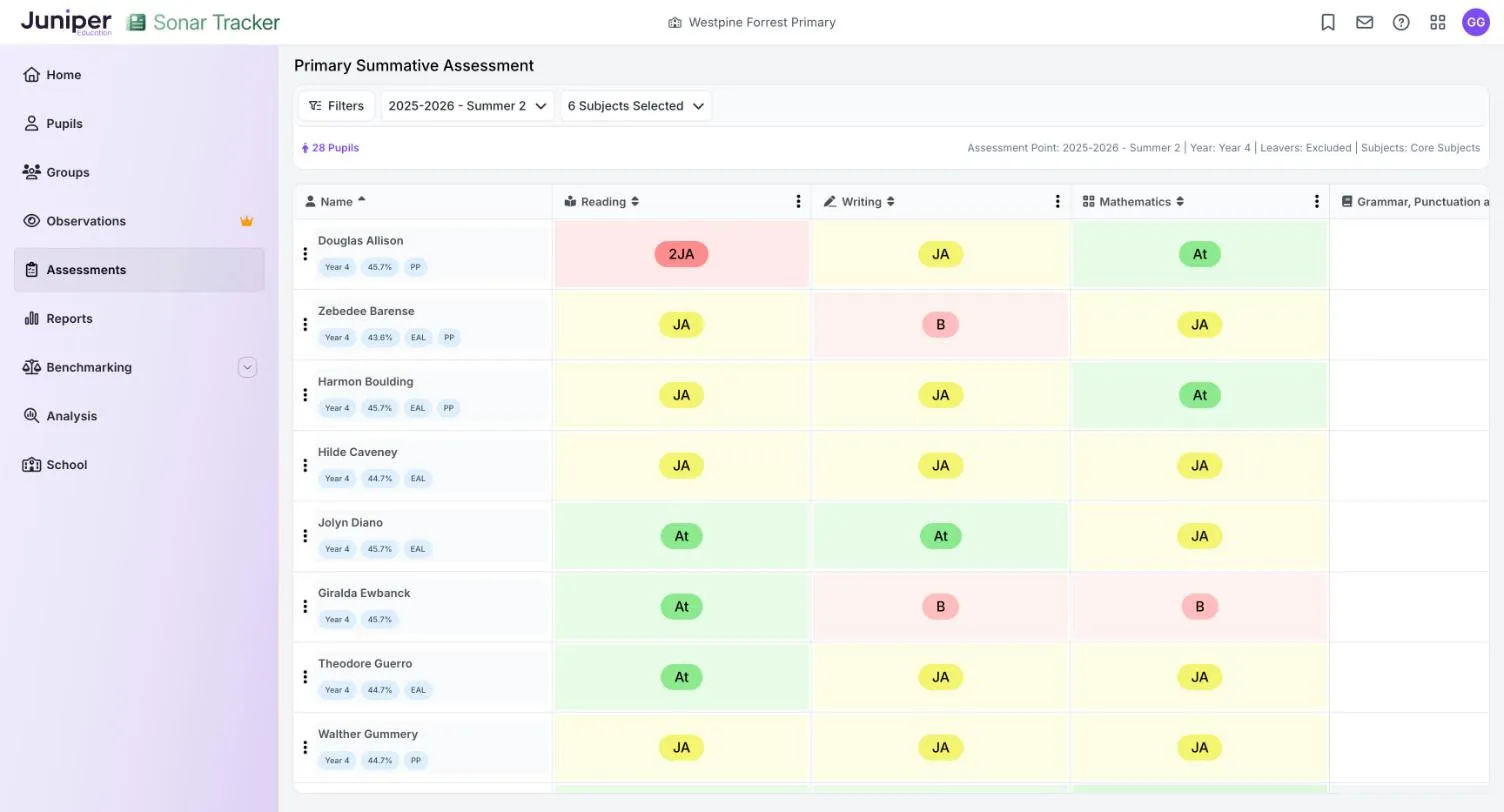
Reports count a judgement from a lower band as Significantly Below and one from a higher band as Significantly Above. Record the band a pupil is really working in: 2At tells the next teacher far more than Below at every assessment point. Assess pupils working below their year group has the steps.
How reports show judgements
Section titled “How reports show judgements”Reports place every pupil in one of seven categories:
| Category | Meaning |
|---|---|
| No Assessment | No judgement at this assessment point |
| Significantly Below | A judgement from a lower year group’s band |
| Below | Below, in the pupil’s own band |
| Just At | Just At, in the pupil’s own band |
| Securely At | Securely At, in the pupil’s own band |
| Above | Above, in the pupil’s own band |
| Significantly Above | A judgement from a higher year group’s band |
Sonar does not carry judgements forward: a pupil judged at autumn 1 but not at autumn 2 shows as No Assessment for autumn 2. Teachers can copy earlier judgements and then review them (Copy judgements from an earlier point).
Expected progress
Section titled “Expected progress”Sonar’s point in time model does not measure progress in points. It compares a pupil’s judgements at two assessment points:
- the same judgement at both points is expected progress, for example Just At to Just At
- a higher judgement is more than expected progress, for example Just At to Securely At
- a lower judgement is less than expected progress, for example Above to Securely At
Keeping the same judgement is real progress. The curriculum moves on every term, and a pupil who stays Just At has kept pace with it. Not every pupil needs to move up.
Individual reports apply their own progress rules and colours, so check each report’s key before you draw conclusions. Progress reports explains how each one counts progress.
A worked example
Section titled “A worked example”These made-up reading judgements follow four pupils in 4 Ruby, a year 4 class at Westpine Forrest Primary (the demo school). The school records judgements at autumn 2, spring 2 and summer 2.
| Pupil | Autumn 2 | Spring 2 | Summer 2 |
|---|---|---|---|
| Zebedee Barense | JA | JA | JA |
| Hilde Caveney | B | JA | JA |
| Harmon Boulding | A | A | At |
| Uta Hunter | 3JA | 3At | 3At |
Zebedee stays Just At all year, which is expected progress. Hilde makes more than expected progress when she moves up to Just At at spring 2, and then holds it.
Harmon drops to Securely At at summer 2. That is less than expected progress, though he is still on track. It is a reason to look at his reading, not a verdict.
Uta is working on the year 3 reading curriculum, so her judgements come from Band 3 and show in red. She has moved up within that band, but reports that compare categories count her as Significantly Below each time and show expected progress. How reports show these pupils explains which reports show what she has learned.
Why Sonar does not count steps or points
Section titled “Why Sonar does not count steps or points”Some trackers turn judgements into points and expect a set number of steps a year. The research explains why Sonar’s model does not.
Points rebuild levels. The Commission on Assessment without Levels (2015) found that levels had become thresholds and that best-fit judgements hid gaps. It warned that new tracking systems should not reinvent levels.
They also suggest precision that is not there. The DfE’s 2018 report ‘Making data work’ warned that asking teachers for many judgement points per pupil introduces “spurious precision”.
And over a single term, most change is noise. Becky Allen shows that measurement error swamps a whole year’s growth for most pupils (Allen, 2018). On a typical 20-question class test, scores must differ by about 8 marks to show that one pupil did better (Coe, 2018). Sam Sims estimates that only 5 to 7% of pupils show a statistically detectable fall over a term (Sims, 2024).
So treat a change of judgement as a reason to look at a pupil’s work, not as a measurement. Talk about progress in curriculum terms: what the pupil can do now that they could not before. The one report that counts codes moved, Summative Progress Analysis, exists so that progress within a band shows for pupils working below their year group.
Renaming judgements
Section titled “Renaming judgements”Your school can rename the judgements on the Summative Code Labels page (Assessment settings), but the meanings stay fixed. Just At always counts as on track, so renaming it At ARE is fine but Just Below is not.
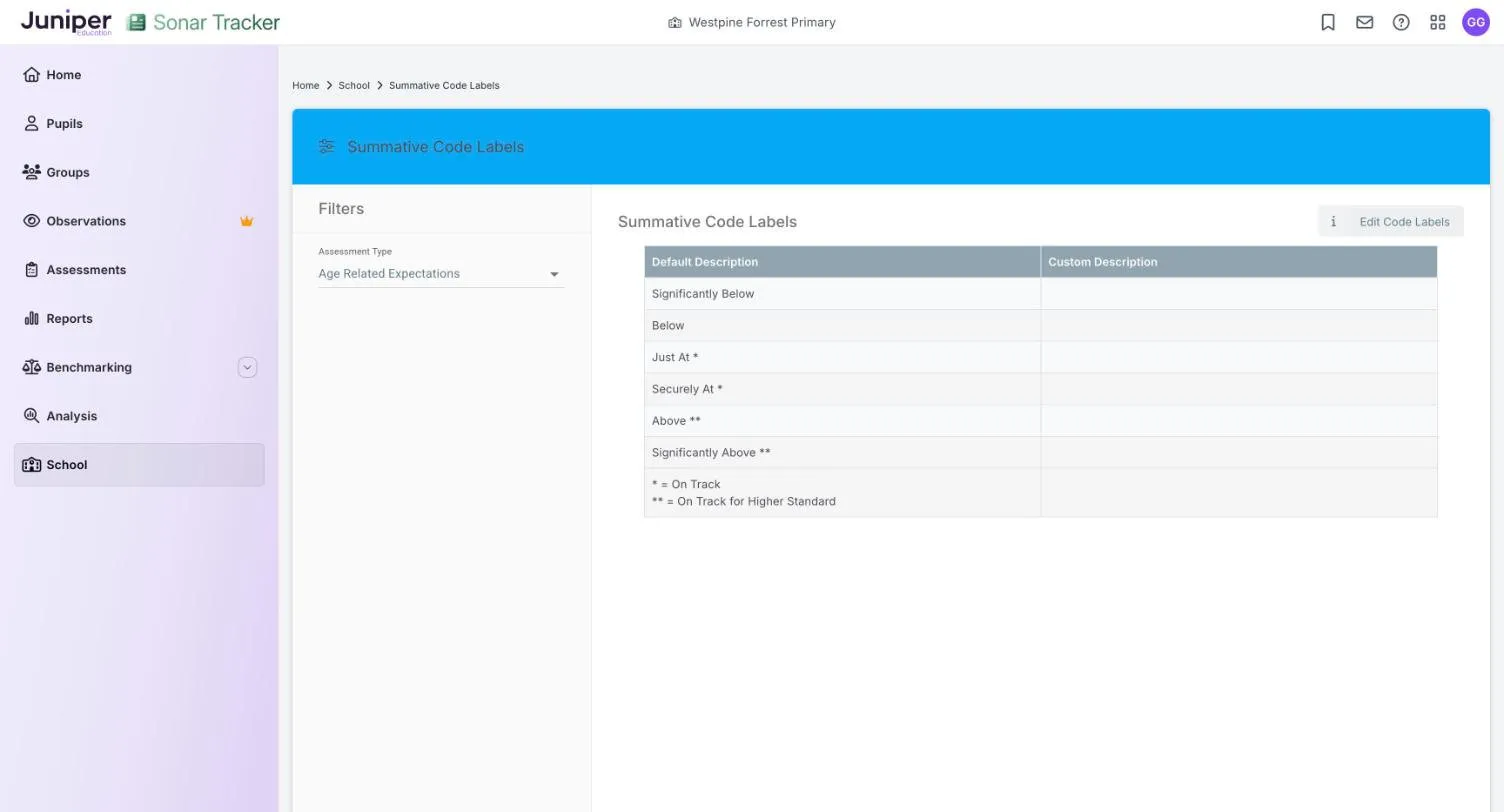
Fixed meanings are what let Juniper compare schools in benchmarking. To change a meaning or use a different set of codes, contact Juniper support. Do it early in the autumn term, before anyone enters judgements, because a new code model applies to the whole academic year.
Judgements and statutory outcomes
Section titled “Judgements and statutory outcomes”A summative judgement is a teacher’s view during the year, not a statutory outcome, even at summer 2 of year 6. Statutory outcomes come from national tests and from teacher assessment against the Standards and Testing Agency (STA) frameworks, and they use different scales. The KS2 tests give scaled scores from 80 to 120. A score of 100 or more meets the expected standard, and 110 or more is the higher standard in reading and maths.
KS2 writing is teacher-assessed as working towards the expected standard (WTS), working at the expected standard (EXS) or working at greater depth (GDS). STA says its teacher assessment frameworks should not be used to track progress through the key stage. Keep those labels for the end of the key stage, and use Sonar’s judgements during the year. Key stage 2 explains how statutory results are recorded.