


 Sisra Analytics
Assessment in Sonar
How assessment works in Sonar
Sonar Tracker holds six kinds of assessment information, from formative records made while teaching to statutory results. Each answers a different question. Read this page before you decide what your school will record, and how often.
What Sonar holds
Section titled “What Sonar holds”| Information | Who records it, and when | What it is for |
|---|---|---|
| Formative assessment | Teachers, against curriculum objectives, when a record helps their planning | Seeing what pupils have and have not yet learned, to plan teaching |
| Summative judgements | Teachers, at the assessment points your school uses | An overall judgement in each subject against age-related expectations (ARE) |
| Test scores | Teachers or office staff, after the school’s own tests | An independent check on teacher judgement |
| Targets and projections | Teachers and leaders, during the year | A goal for the end of the year, and a forecast of where each pupil is heading |
| Statutory results | Imported from a common transfer file (CTF) or entered by hand | The national assessments, from the early years foundation stage profile (EYFSP) to KS2 |
| Observations | Staff, as learning happens (Observations module only) | Notes and photos about pupils, which can be shared with parents |
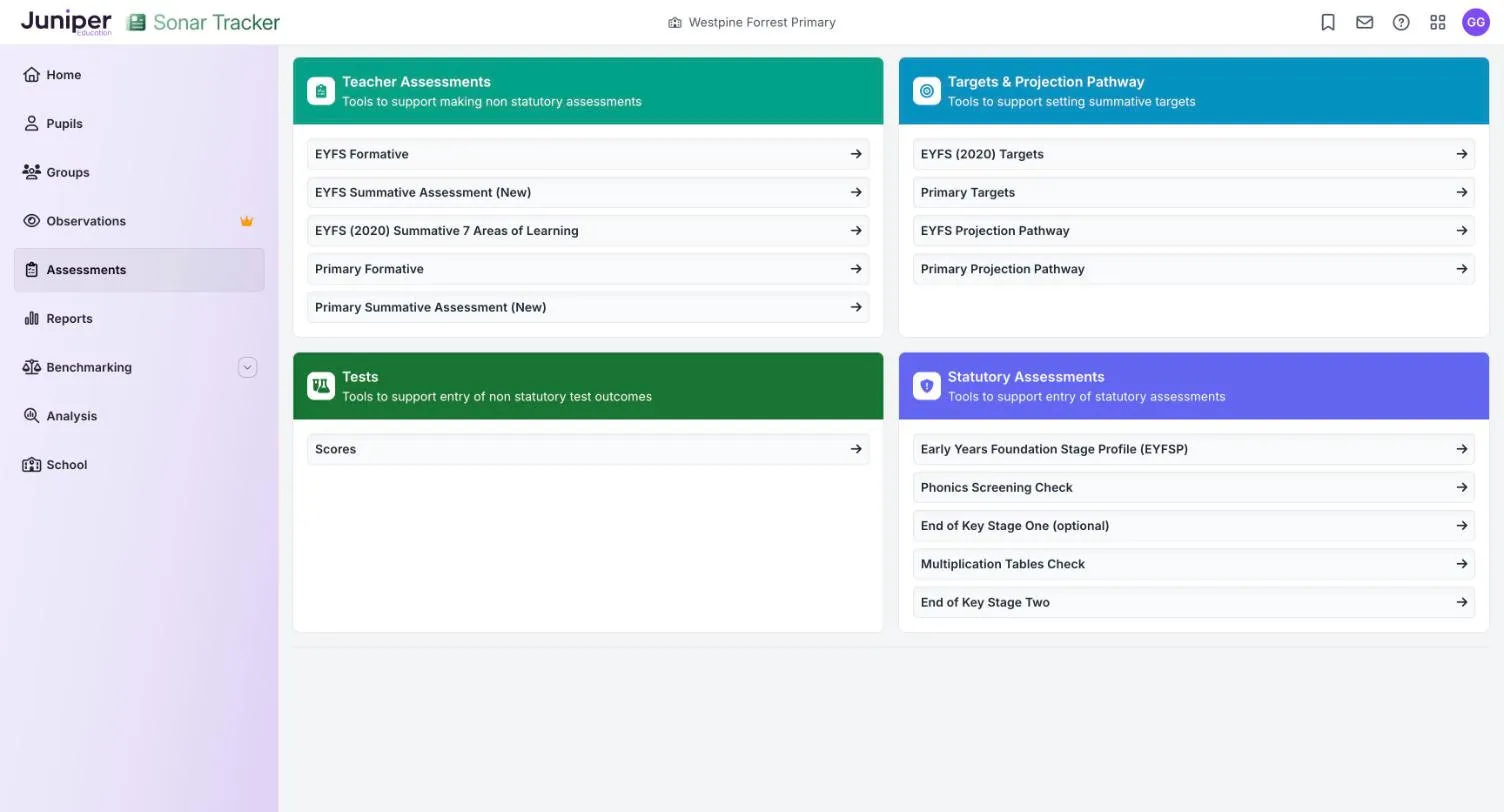
The Assessments page groups the entry screens into four cards: Teacher Assessments, Targets & Projection Pathway, Tests and Statutory Assessments. Observations have their own item in the left menu.
Formative assessment
Section titled “Formative assessment”Formative assessment is the checking teachers do while they teach, through questions, tasks, conversation and feedback. Most of it happens in lessons and never needs writing down. Where a record helps, teachers can judge pupils against curriculum objectives on the Primary Formative and EYFS Formative pages. Juniper Education’s default objectives are called the Sonar Curriculum.
Each objective takes one of five codes: Not taught or pupil was absent, Taught, Working Towards, Achieved and Greater Depth. The entry screen shows them as colours without labels, so Record formative assessment gives the colour key.
Summative judgements
Section titled “Summative judgements”A summative judgement is a teacher’s overall view of where a pupil is in a subject at one assessment point, such as autumn 2. Sonar’s default judgements are Below, Just At, Securely At and Above, and reports, dashboards, benchmarking and parent reports all use them.
Each judgement says whether the pupil is on track to meet the expectations for their year group by the end of the year. It is based on what has been taught so far. Judgements, bands and age-related expectations explains each one.
Test scores
Section titled “Test scores”The Scores page holds results from tests your school chooses to use, such as standardised tests from a publisher. Your school sets which scores count as below, at or above expectations, so that reports can show test results beside teacher judgements. A standardised score of 100 is an average, not the expected standard: Enter test scores explains the difference.
Targets and projections
Section titled “Targets and projections”An End of Year Target is what the teacher would like a pupil to achieve. It is set early in the year and rarely changes.
An End of Year Projection is a forecast of where the pupil is likely to end up if nothing dramatic changes. It can rise or fall during the year. Both use the summative codes. See Set targets and end-of-year projections.
Statutory results
Section titled “Statutory results”The Statutory Assessments card holds the results of the national assessments:
- the EYFSP, at the end of reception
- the phonics screening check
- the optional end of KS1 assessments
- the multiplication tables check (MTC)
- the end of KS2 tests and teacher assessment
Enter each result in one system only, and move results between systems with a CTF. The Statutory Dashboard, under Analysis, summarises the results and compares each with the previous year. See Statutory assessment in Sonar.
Sonar does not hold the statutory reception baseline assessment (RBA), because schools never receive the scores. See The start of year baseline.
Observations
Section titled “Observations”With the Observations add-on module, staff can record short notes and photos about pupils. An observation published for Home goes to Comms Hub for approval before parents see it in the Juniper Education app. Observations are for sharing learning, especially with parents, not evidence you have to collect. See About observations.
How the pieces connect
Section titled “How the pieces connect”Sonar brings the kinds of information together in three places. None of them makes a judgement for you.
| Where | What it brings together | When to use it |
|---|---|---|
| Triangulate, on the summative entry page | For one pupil and subject: the formative breakdown, latest test score, target, statutory results and last summative judgement | While you decide a judgement |
| Primary Triangulation of Data Analysis report | Statutory, summative, formative, test, target and projection data for a class or year group | Moderation and pupil progress meetings |
| Primary Flight Path report | One subject across a pupil’s time in school: statutory results, each year’s summer 2 judgement, the current judgement and the projection | Seeing a pupil’s history, and at transition |
Triangulation means checking one piece of evidence against others. It works best when the other evidence is independent of the judgement, such as a test, a sample of pupils’ work or a statutory result. Formative codes entered by the same teacher are a useful prompt, but they are not independent.
Why formative and summative are kept apart
Section titled “Why formative and summative are kept apart”Formative assessment has a strong research base. Black and Wiliam’s 1998 review, Assessment and Classroom Learning, drew on about 250 research publications. It found that strengthening classroom feedback produced substantial gains in learning. Their summary for teachers, Inside the Black Box, reported larger gains for lower attainers. It also found that marks on their own did not help pupils learn.
Later estimates are more cautious, and results depend on how well feedback is done. The Education Endowment Foundation (EEF) puts the average impact of feedback at about 6 months’ additional progress, with wide variation between studies.
Wiliam and Thompson’s five strategies, from sharing success criteria to helping pupils own their learning, all happen between teacher and pupils. None of them needs a tracker.
Daisy Christodoulou argues in ‘Making Good Progress?’ (2017) that formative and summative assessment need different designs (review by Tom Sherrington). Formative assessment should be frequent, low-stakes and focused on specific content. Summative assessment should be infrequent and cover a broad sample of the subject in standard conditions. Adding up formative records to produce a summative judgement serves neither purpose well. Teachers read objective statements in different ways, and ticking them off encourages teaching to the statement.
So Sonar leaves summative judgements to teachers and never calculates them from formative codes. Triangulate shows the formative picture beside the judgement list, but the judgement is the teacher’s.
What the data cannot tell you
Section titled “What the data cannot tell you”Teacher judgements and test scores are reasonable estimates of attainment. They are much weaker at measuring one pupil’s progress over a term, as Why Sonar does not count steps or points explains.
Data also shows you where to look, not why. A pupil judged Below needs someone to look at their work and talk to them before anyone decides what to do. And a teacher’s judgement is not a statutory outcome: see Judgements and statutory outcomes.